

By Amanda Weilenmann, Infinitum
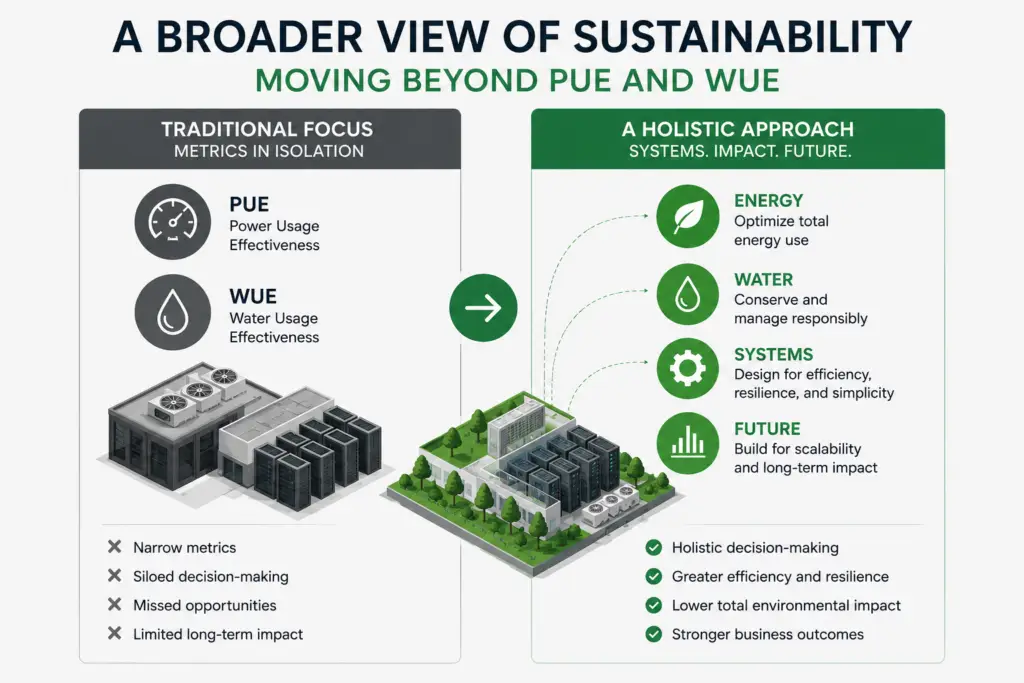
For years, the data center industry has relied on two familiar metrics to measure environmental performance: Power Usage Effectiveness (PUE) and Water Usage Effectiveness (WUE). These numbers became the industry’s shorthand for efficiency – simple, standardized ways to quantify how facilities consume two of their most critical resources.
They mattered then, and they still matter today.
But at the GBI Data Center Sustainability Seminar, one theme surfaced repeatedly across panels, side conversations, and industry discussions: operational efficiency metrics alone are no longer enough.
The industry has been measuring sustainability with a ruler when what it increasingly needs is a compass.
The Limits of Efficiency Metrics
PUE and WUE were designed to answer a specific operational question: how much waste exists within a system?
That remains an important question. But it does not fully address whether the right system was built in the right location, using the right resources, in alignment with the needs of the surrounding community.
A data center can post excellent PUE and WUE numbers while still drawing water from an aquifer relied upon by agriculture. It can operate efficiently while adding strain to a regional grid not designed for rapid load growth. It can optimize thermal management and still generate local opposition because the community was never meaningfully engaged.
Efficiency alone does not equal sustainability.
What emerged throughout the seminar was a broader definition of responsibility – one that considers operational performance alongside environmental context, infrastructure constraints, and community impact.
Water as a Case Study in Complexity
Water may be the clearest example of why sustainability in data centers cannot be reduced to a single metric.
Public perception often treats data centers as universally water-intensive. The reality is far more nuanced. Water usage varies dramatically depending on climate, geography, cooling architecture, and local resource availability.
A facility using direct-to-chip liquid cooling within a closed-loop system may consume little to no process water beyond normal day-to-day human use. A facility dependent on evaporative cooling towers in a water-stressed region presents an entirely different set of tradeoffs.
What stood out during the water discussions in Dallas was not a consensus around one “correct” cooling strategy. Instead, the conversation focused on context.
The more important question is not simply, “How do we minimize WUE?” but rather, “What should this specific location prioritize?”
In agricultural regions where communities depend on limited groundwater resources, competing for water may be unacceptable regardless of a facility’s WUE score. In regions where water is relatively abundant but power infrastructure is constrained, evaporative cooling may reduce electrical demand and produce a more balanced environmental outcome.
There is no universal formula.
Sustainability in data center infrastructure increasingly requires localized decision-making – understanding what a region can support and what it cannot afford to lose.
A Three-Way Tension Shaping the Industry
Stepping back from the seminar, one underlying tension connected many of the conversations. While the specifics differ by market, most data center developments are balancing three interconnected pressures:
Water Availability
In stressed watersheds, water is not simply an operational input. Every gallon carries implications for agriculture, municipalities, and long-term community trust.
Power Availability and Grid Stability
In high-growth regions such as Texas, power capacity is no longer something operators can assume will be readily available. Large-scale load growth increasingly requires coordination between developers, utilities, regulators, and policymakers. In some cases, operators are investing directly in generation and infrastructure to support expansion.
Community Expectations
The era of building first and explaining later is rapidly disappearing. Communities are more informed, more organized, and more active in local permitting discussions than ever before. The projects gaining long-term support are often the ones engaging stakeholders early – before opposition takes shape.
These pressures do not exist independently. They influence one another in ways that are highly localized.
A design approach that makes sense in Nebraska may be entirely inappropriate in Arizona. Sustainability is no longer a static checklist. It is an ongoing discipline of balancing competing constraints responsibly.
Where Fans Fit into the Conversation
One point that resonated throughout the seminar was that infrastructure decisions are becoming more situational and application-specific.
In facilities where evaporative cooling is not viable due to water constraints, airflow becomes increasingly important as the primary thermal management strategy. But even here, the answer is not simply “more cooling.”
The more sustainable approach is precision: deploying exactly the level of airflow and power required for the application – and no more.
That philosophy aligns closely with how Infinitum approaches fan system design. Right-sized systems that minimize unnecessary energy draw, combined with modular architectures and field-replaceable variable frequency drives (VFDs), can help extend equipment life and reduce unnecessary replacement cycles.
As the industry begins evaluating sustainability more holistically, lifecycle efficiency and maintainability are becoming increasingly important parts of the conversation.
Sustainability Is Ultimately About Systems
The most meaningful takeaway from the seminar was not tied to a specific technology or metric. It was the broader idea of accountability.
Real sustainability cannot be captured by a single number. It is reflected in the cumulative impact data centers have on the environmental, economic, and social systems around them.
That includes engaging communities before construction begins. It means being transparent about the distinction between water withdrawal and water consumption. It means recognizing that a data center can become either a long-term community asset or a source of frustration depending on how operators choose to engage.
What was encouraging in Dallas was the seriousness with which the industry is approaching these conversations.
Sustainability frameworks and certification standards continue to evolve. The discussion is also expanding beyond traditional engineering disciplines. Community engagement leaders, policy specialists, and materials experts are now contributing alongside infrastructure and operations teams.
PUE and WUE will remain important measures of operational performance. But the industry is recognizing that they are only part of a much larger sustainability equation.
This post reflects themes and insights from the GBI Data Center Sustainability Seminar, Dallas 2026.